
Checking Criminal History in Lansing
A Lansing records search should move from the likely responding agency to county custody and court channels. There is no verified Lansing police database to search first. The Ashe County Sheriff's Office is the usual source for Lansing law-enforcement reports, while the jail holds booking and current-custody information. The clerk and North Carolina eCourts Portal show what became a Lansing criminal case. Each source has its own update pace.
Follow these five steps to check Lansing criminal records without losing the trail:
- Identify the Lansing event date, place, and possible responding agency. A Lansing state-road crash may belong to Highway Patrol rather than the sheriff.
- Call Ashe communications at 336-846-5600 when the Lansing agency is unclear, or contact the sheriff at 336-846-5633 for a releasable Lansing incident or arrest record.
- Review the sheriff's monthly booking archive for a historical snapshot, then call 336-846-5611 if current custody must be confirmed.
- Search North Carolina eCourts Portal by name or case number, selecting Ashe County rather than looking for Lansing as a court location.
- Contact the Ashe Clerk of Superior Court at 336-219-1400 for a paper file, courthouse terminal search, or certified county search.
Lansing Has No Police Records Unit
No municipal police department, police records unit, police app, local arrest blotter, or police request form was verified for Lansing. That Lansing service gap should not be filled with a neighboring department. Most Lansing law-enforcement records route to the Ashe County Sheriff's Office at 140 Government Circle in Jefferson. Its main line is 336-846-5633, and communications can be reached at 336-846-5600.
The absence of a Lansing police office changes the first search step. Ask which agency responded before requesting a Lansing report. The sheriff may have the incident file, but North Carolina State Highway Patrol can hold a state-road crash record. A state or federal agency may also keep the investigation it led. The county jail's booking entry identifies the arresting agency and can provide a useful Lansing lead, but jail staff do not become custodians of another agency's full investigative report.
Lansing Police Department Records
There is no verified Lansing Police Department. For a law-enforcement report tied to Lansing, use the official Ashe County sheriff contact listing or the Sheriff's Office itself. A clear Lansing request should provide the event date and time, location, report or warrant number if known, agency name, exact record, and preferred inspection or copy format. No Lansing-specific online records portal or published local fee schedule was found.
North Carolina law requires access to specified Lansing arrest and event facts, but it does not make every police narrative public. The public portion can include the nature, time, date, and location of an apparent violation, investigating officers, whether an arrest or charge occurred, and the circumstances surrounding an arrest. Witness material, evidence, protected victim information, juvenile records, body-camera video, and an active investigative file can follow stricter Lansing access rules.
Lansing Criminal Record Custodians
The Lansing town office, sheriff, and court clerk serve different public roles. Sending every Lansing request to Town Hall can add delay because Lansing town staff are not custodians of county incident reports or criminal case files.
| Office | Record Held | When to Use It |
|---|---|---|
| Lansing town office | Municipal administrative records | Town business, not sheriff reports or court cases |
| Ashe County Sheriff | Sheriff incident, arrest, booking, and custody records | County response, jail intake, or current custody |
| Ashe Clerk of Superior Court | District and Superior Court criminal files | Filed charges, hearings, dispositions, judgments, and certified searches |
If Lansing Town Hall does not have a police report, do not reframe the same request as a town administrative request. Ask staff only for the correct Lansing route, then contact the agency that created the record. The official Lansing site remains the proper source for town history and municipal services.
Lansing Arrests and Bookings
Lansing has no town jail. A person arrested in or near Lansing is booked at the Ashe County Detention Center at 140 Government Circle in Jefferson. The Lansing booking file can include an ID number, booking and release dates, arresting agency, warrant or court case number, charge description and jurisdiction, bond amount and type, offense level, and pretrial status. It is a Lansing custody record, not a final finding of guilt.
The sheriff publishes monthly Lansing-related Booking Report PDFs in its official crime archive. A report can reveal an arresting agency or Lansing case-number lead, but it is a dated snapshot and may list someone released during that month. It does not change when a charge is amended, dismissed, or resolved. Call the jail at 336-846-5611 for current custody, then use the court file to learn what happened to the Lansing charge.
Lansing Booking Report Trail
A monthly booking PDF can help when the only Lansing starting facts are a name and an approximate month. Look for the arresting agency, booking date, warrant or case number, and Ashe suffix. Use those fields as Lansing record leads. Do not treat the charge stated at jail intake as the prosecutor's final choice or the court's disposition.
Next, move to Portal and search the Lansing case number or name under Ashe County. A very recent Lansing booking may appear before the court record is fully populated. If the court search stays blank, verify the format, try a narrow wildcard search, and call the clerk rather than concluding that no case exists. For details about the county jail layer, the Ashe County arrest lookup covers all documented access channels.
Note: Monthly booking reports count bookings, not unique people, convictions, or a Lansing-specific crime total.
Municipal Court Records in Lansing
Lansing does not operate a separate municipal court or court portal. Lansing criminal, traffic, and ordinance matters proceed through Ashe County District or Superior Court according to the charge and stage. District Court handles Lansing misdemeanors, infractions, and preliminary felony matters. Superior Court handles felony trials and misdemeanor appeals. Search by party or case number in North Carolina eCourts Portal and choose Ashe County as the location.
The local court channel has these core features:
| Court Name | Ashe County District Court and Superior Court |
|---|---|
| Case Types Heard | Traffic and ordinance matters, infractions, misdemeanors, felony preliminary matters, felony trials, and appeals as provided by law |
| Case Lookup Channel | North Carolina eCourts Portal, courthouse public terminal, clerk counter, or certified Ashe County search |
| What the Docket Shows | Case number, filing date, status, parties, charges, events, hearings, disposition, and financial details when present |
| Copies & Fees | Inspection and copies through the clerk; a certified name-based Ashe County search costs $25 |
Portal excludes sealed and confidential Lansing files, sensitive documents, and victim identities from public returns. The courthouse terminal and clerk counter are the Lansing fallback for paper documents, older converted material, or certification.
Lansing Criminal Records Before Travel
Lansing sits in a dispersed mountain county, so an unnecessary trip to Jefferson can take real time. Search Lansing records online before traveling. Portal can confirm whether a Lansing criminal case exists and show public summary fields. The monthly booking archive can supply a past custody lead. A jail call can confirm present custody. A call to the clerk can establish whether the needed paper record or certified search belongs at the courthouse.
The Ashe County court contact directory is the source for the court image below.
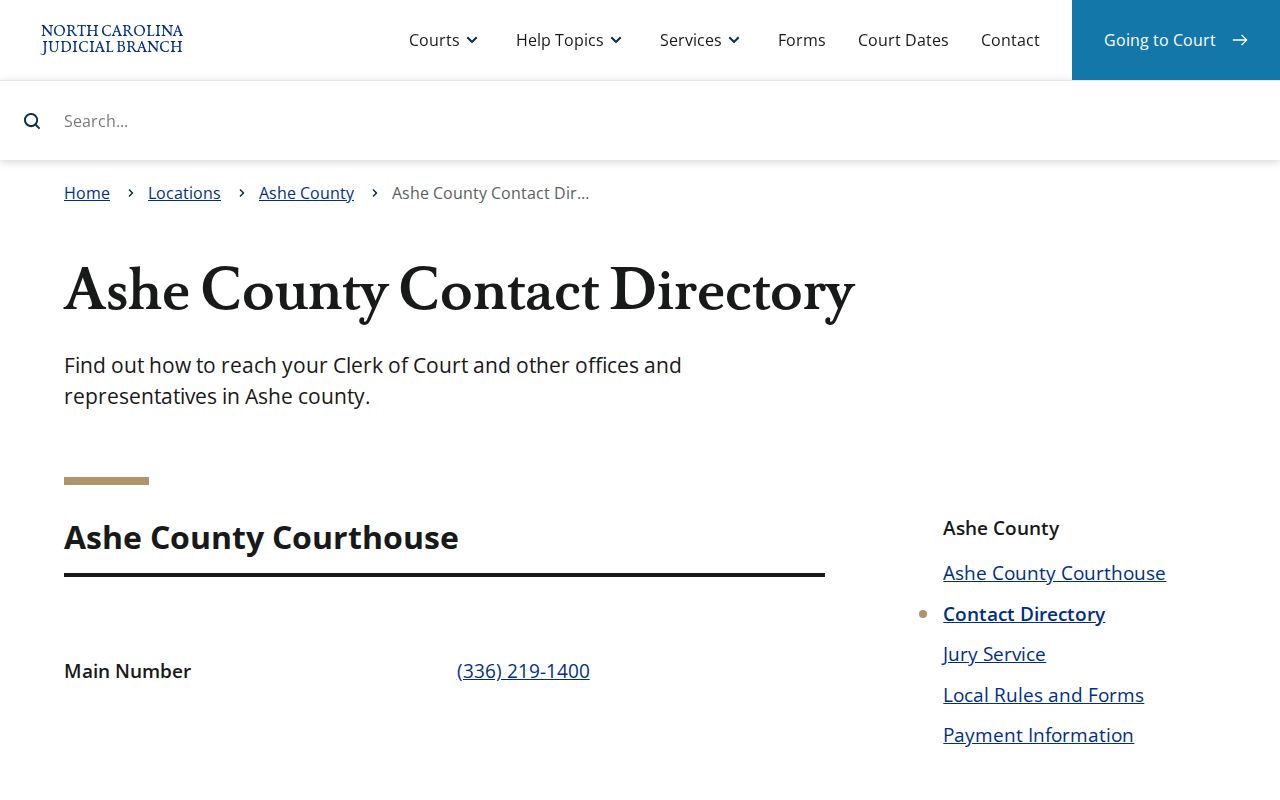
The directory helps a Lansing requester call the correct clerk, magistrate, or court office before leaving Lansing. It also reinforces that Lansing criminal files are county court records. The active courthouse is at 150 Government Circle, not the historic courthouse on East Main Street.
Where Lansing Records Go
A sheriff response near Lansing creates a Lansing agency report. If an arrest follows, the Ashe County Detention Center creates a Lansing intake record and ordinarily takes identifying data and fingerprints. A magistrate handles initial judicial process and release conditions. The prosecutor decides which charge proceeds, and the clerk maintains the District or Superior Court file. Fingerprint and disposition data can later reach the state repository.
Record flow: Ashe County Sheriff's Office serving Lansing › Ashe County Courts › North Carolina State Bureau of Investigation
These Lansing records remain related but nonidentical. The sheriff report can exist with no prosecution. A booking PDF can remain after release. Portal can show a Lansing event before all state fingerprint links are complete. For one's own statewide fingerprint-supported record, use NCSBI Right to Review. For a Lansing court outcome, rely on the clerk's case file.
Lansing Addresses and Arrest Records
A Lansing mailing address is not proof that an event occurred inside incorporated town limits. Rural postal routes can extend beyond a municipality, and multiple law-enforcement agencies may operate in the area. Avoid choosing a custodian from the address alone. The arresting-agency field, report number, citation, crash form, warrant, or court entry gives better evidence.
When the Lansing agency remains uncertain, call Ashe communications with the event date, time, and place. For a Lansing state-road collision, check whether Highway Patrol investigated. For a sheriff response, contact the Sheriff's Office. The town office can address its own administrative files but should not be expected to release a sheriff report, a detention record, or a clerk's criminal case. This one distinction resolves many failed Lansing record requests.
Lansing History and Record Routes
Lansing began as a trading center for the area's agrarian population. It remains the smallest incorporated town in Ashe County, with 126 residents counted in the 2020 Census. Its size helps explain the absence of a verified municipal police department and separate court channel, but it does not make town-related criminal records vanish. County offices perform those functions.
No official municipal police source provides a Lansing offense count, so county booking totals cannot be converted into a town crime rate. Use Ashe Sheriff or official state agency statistics only with the proper agency and year label. News stories and booking PDFs measure different things. A booking report counts intake events, while a court case tracks prosecution and a police report records an agency response.
Public Access Rules in Lansing
North Carolina public access depends on the record and its custodian. The sheriff releases specified arrest and event facts while most criminal investigative records remain nonpublic. The clerk provides public inspection and copies of court files subject to confidentiality laws. Sealed cases, juvenile records, protected identifiers, victim data, sensitive documents, and some body-camera material will not appear through an ordinary public request or Portal search.
Key Statutes:
North Carolina Public Records Law, G.S. 132-1 and 132-6 provides broad inspection rights unless another law makes a record confidential.
G.S. 132-1.4 protects investigative files in general while identifying arrest and event facts that agencies must make public.
G.S. 7A-109 places public court-file inspection and copying with the clerk, subject to legal limits.
Describe the existing record as narrowly as possible. Give the date, place, responding agency, report or case number, and desired format. A public-record request does not require an office to create a new analysis or answer a broad question about a person.